


Blackjack is the only game in the BB56 Live Casino lobby where player decisions directly dictate the house edge. Unlike Roulette or Baccarat—where payouts are fixed regardless of player behavior—the house in Blackjack is strictly bound by programmed dealer drawing rules, while the player possesses complete tactical autonomy: to Hit, Stand, Double Down, Split, or Surrender.
By applying mathematically verified Basic Strategy, players can reduce the casino’s advantage to approximately 0.50% (a Return to Player of 99.50%). Conversely, relying on intuition or mimicking the dealer’s conservative style increases the house edge to 2.5% or higher.
Quick Facts: BB56 Live Blackjack Rules Snapshot
| Rule / Feature | Standard BB56 Live Table | Impact on House Edge |
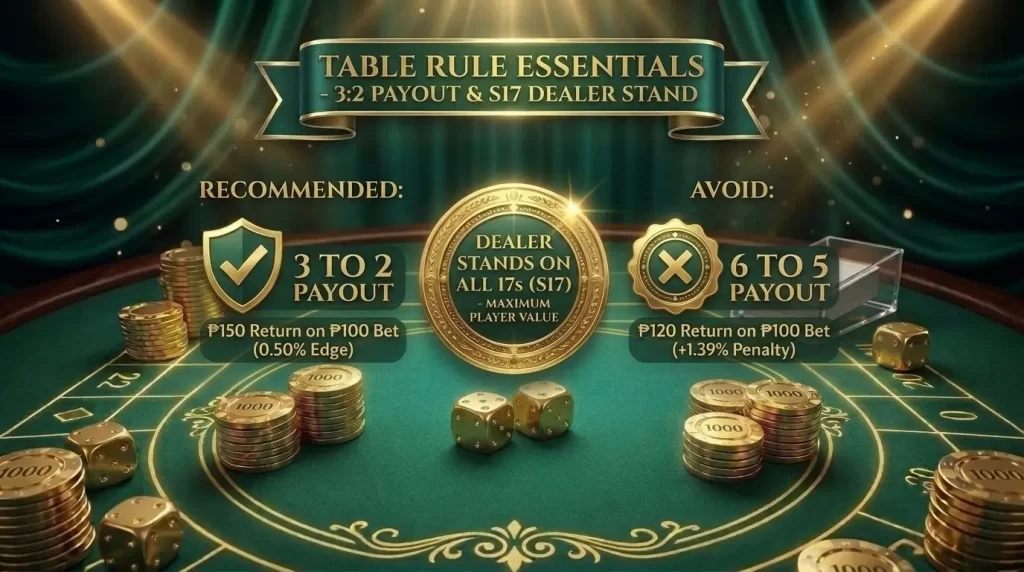
| Natural Blackjack Payout | 3 : 2 (Avoid 6:5 tables) | Baseline (6:5 adds +1.39% house edge) |
| Dealer Rule on 17 | Dealer Stands on all 17s (S17) | Player-friendly (H17 adds +0.22% house edge) |
| Shoe Size | 8 Decks (Continuous Shuffle or Manual Shoe) | Standard international shoe |
| Double After Split (DAS) | Permitted on all 2-card totals | Reduces house edge by -0.14% |
| Surrender Option | Late Surrender available on selected tables | Reduces house edge by -0.08% |
| Base Currency / Limits | Philippine Peso (PHP) / ₱50 to ₱50,000+ | Supports GCash & Maya settlements |
| Studio Providers | Evolution Gaming, Pragmatic Play Live | HD real-time live video feeds |
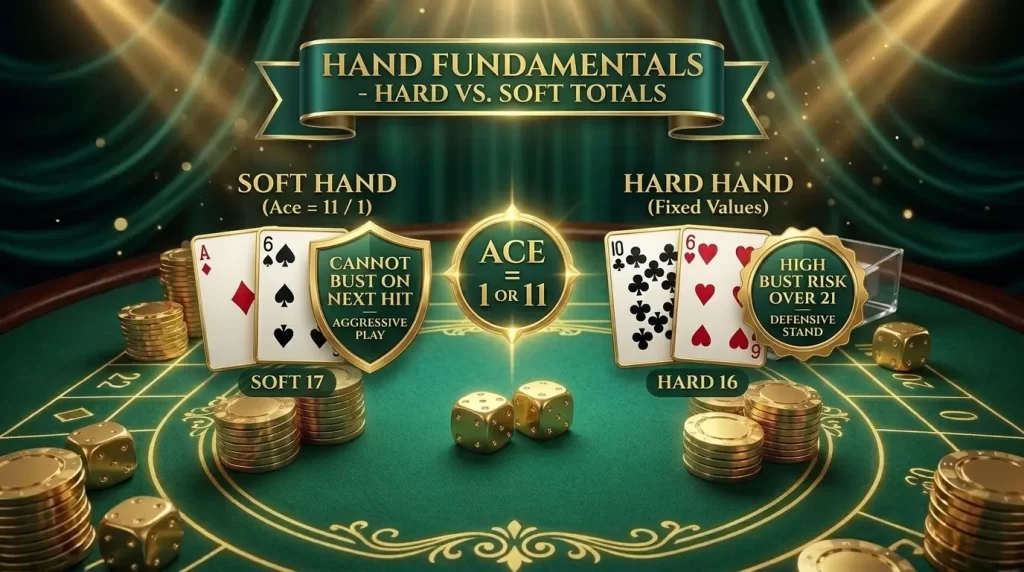
Hand Fundamentals: Hard Hands vs. Soft Hands
In Blackjack, card values are standardized: Cards 2 through 10 carry their face value, face cards (Jack, Queen, King) count as 10, and Aces count as either 1 or 11.
- Soft Hands (Contain an Ace counted as 11): Example: A-6 (Soft 17). Because drawing a 10 drops the Ace to a value of 1 without busting (e.g., A-6-10 = 17), soft hands allow aggressive hitting and doubling opportunities against weak dealer upcards.
- Hard Hands (No Ace, or an Ace forced to count as 1): Example: 10-6 or A-7-9 (Hard 17). Drawing any card with a value higher than 4 results in an immediate Bust (loss). Hard hands above 11 require defensive decisions based on the dealer’s upcard.
The Core Dealer Rule: S17 vs. H17
Live Blackjack dealers at BB56 operate without discretion: they must draw on any hand totaling 16 or lower, and must stand on 17 or higher. However, the specific soft-17 rule on the table card dictates table value:
- Dealer Stands on Soft 17 (S17): The dealer must stand on A-6. This is the preferred player rule, preserving the optimal 0.50% house edge.
- Dealer Hits Soft 17 (H17): The dealer draws another card on A-6. This rule grants the dealer an extra opportunity to improve weak hands, increasing the house advantage by +0.22%.
Pro Tip: Always check the virtual table felt or click the table rules icon before placing your first chip. Prioritize BB56 tables displaying: “Dealer must stand on all 17s” and “Blackjack pays 3 to 2”.
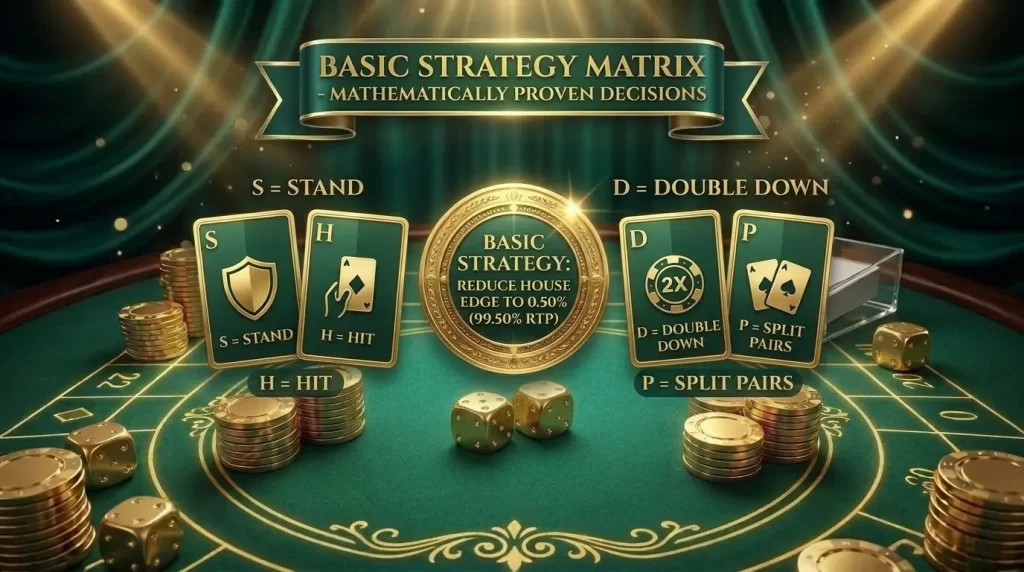
BB56 Optimal Basic Strategy Matrices
The following tables present mathematically proven decisions for standard multi-deck tables where the Dealer Stands on Soft 17 (S17) and Double After Split (DAS) is permitted:
- S = Stand
- H = Hit
- D = Double Down (Hit if doubling is not permitted)
- P = Split into two separate hands
- Rh = Surrender if permitted; otherwise, Hit
Table A: Hard Totals
| Your Hard Total | Dealer 2–3 | Dealer 4–6 | Dealer 7–9 | Dealer 10 | Dealer Ace |
| 17 – 21 | S | S | S | S | S |
| 16 | S | S | H | Rh | Rh |
| 15 | S | S | H | Rh | H |
| 13 – 14 | S | S | H | H | H |
| 12 | H | S | H | H | H |
| 11 | D | D | D | D | H |
| 10 | D | D | D | H | H |
| 9 | H | D | H | H | H |
| 5 – 8 | H | H | H | H | H |
Table B: Soft Totals (Ace counted as 11)
| Your Soft Hand | Dealer 2–3 | Dealer 4 | Dealer 5–6 | Dealer 7–8 | Dealer 9–A |
| Soft 20 (A,9) | S | S | S | S | S |
| Soft 19 (A,8) | S | S | D (vs 6) / S | S | S |
| Soft 18 (A,7) | S | D | D | S | H |
| Soft 17 (A,6) | H | D | D | H | H |
| Soft 15 – 16 (A,4–A,5) | H | D | D | H | H |
| Soft 13 – 14 (A,2–A,3) | H | H | D | H | H |
Table C: Pair Splitting
| Your Pair | Dealer 2–3 | Dealer 4–6 | Dealer 7 | Dealer 8–9 | Dealer 10–A |
| A,A & 8,8 | P | P | P | P | P |
| 10,10 | S | S | S | S | S |
| 9,9 | P | P | S | P | S |
| 7,7 | P | P | P | H | H |
| 6,6 | P | P | H | H | H |
| 5,5 | D | D | D | D | H |
| 4,4 | H | P (vs 5–6) / H | H | H | H |
| 2,2 & 3,3 | P | P | P | H | H |
The Mathematical Trap of Insurance and Even Money
When the dealer shows an Ace, the digital interface prompts: “Insurance? (Pays 2 to 1)”.
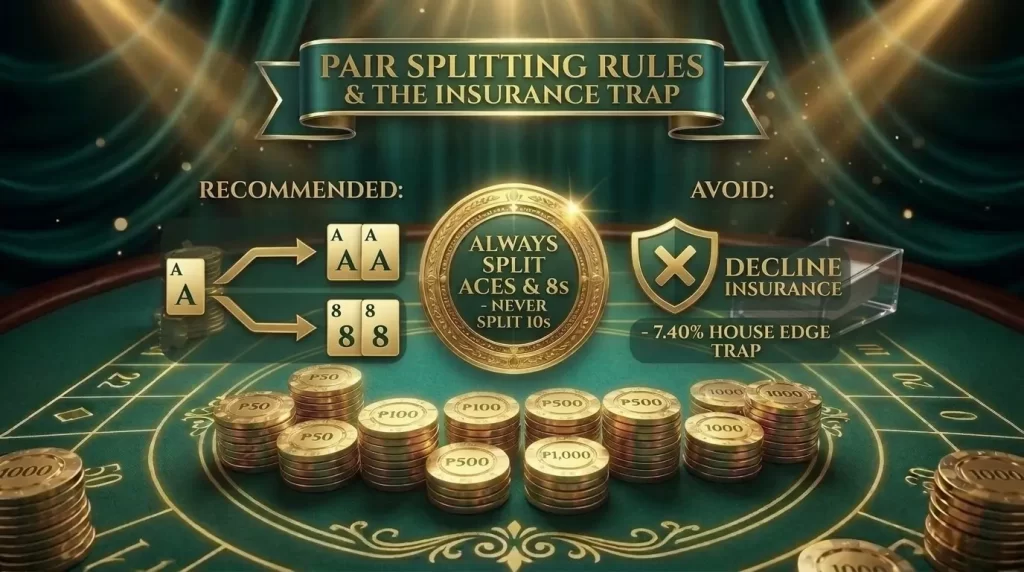
- The Reality of Insurance: The side bet wagers that the dealer’s hole card is a 10-value card (10, J, Q, K). In an 8-deck shoe (416 cards), there are 128 tens. The mathematical probability of the dealer holding a 10 is: 128415≈30.84%\frac{128}{415} \approx 30.84\%415128≈30.84% Paying 2:1 on an event that occurs only 30.84% of the time imposes a massive 7.40% house edge. Basic strategy dictates: Always decline insurance.
- Even Money on Blackjack: Taking “Even Money” when you hold a natural Blackjack against an Ace is mathematically identical to purchasing insurance. Over thousands of hands, declining even money yields an average return of 1.04 units per hand, compared to exactly 1.00 unit if you take the guaranteed payout.
Bankroll Sizing and Volatility Management
Because live dealer hands resolve in roughly 45 to 60 seconds, bankroll discipline is critical:
- Unit Sizing: Set your base betting unit at 1% to 2% of your total session bankroll (e.g., wager ₱50 per hand on a ₱5,000 bankroll).
- Buffer for Splits & Doubles: Basic strategy requires doubling down and splitting pairs when favorable. If your unit is too large, you may feel psychological pressure to skip a mathematically mandatory double, which forfeits your statistical edge.
- Session Discipline: Set clear stop-win and stop-loss boundaries before joining a live table via your BB56 app or browser.
Frequently Asked Questions (FAQ)
What is the mathematical house edge of Blackjack at BB56?
When playing standard tables (3:2 payout, S17, 8 decks) with strict Basic Strategy, the house edge is approximately 0.50% (99.50% RTP), making it the lowest house advantage in the casino.
Why should I never split a pair of 10s?
A pair of 10s gives you a total of 20, which wins over 88% of rounds. Splitting breaks up a near-certain winning hand into two uncertain hands, statistically reducing your net profit.
Should I always split Aces and Eights?
Yes. A pair of Aces (totaling 2 or 12) becomes two hands starting with 11 (the strongest starting value in the game). A pair of 8s totals 16 (the weakest total in blackjack); splitting resets them into two playable hands starting with 8.
Why should I avoid tables that pay 6 to 5 for Blackjack?
A 6:5 payout awards only ₱120 on a ₱100 bet, compared to ₱150 on a standard 3:2 table. This discrepancy inflates the house edge from 0.50% to roughly 1.89%, costing you almost four times more per session.